CIRUS
A next-generation strategic-grade Fiber Optic Gyro (FOG) Inertial Reference Unit for spacecraft attitude control — four fully redundant gyros, rad-hard electronics, and dual-redundant interfaces built on more than 60 years of space heritage.
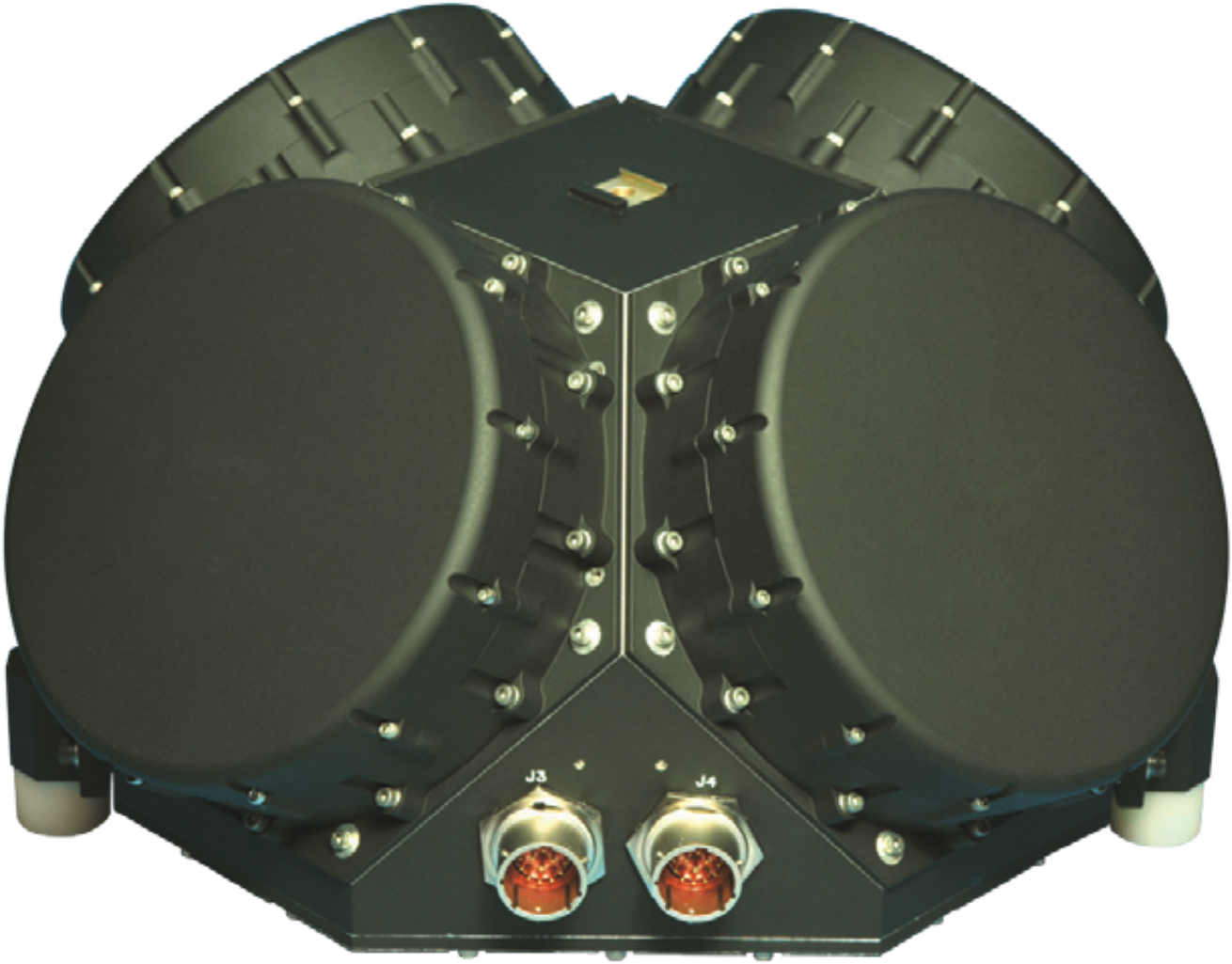
Four gyros, one integral chassis
Built on over sixty years of space heritage, CIRUS is designed and qualified as the next generation of our heritage system. It combines strategic-grade performance with a compact, low-cost integral chassis: four Fiber Optic Gyro (FOG) sensors operating in a fully redundant configuration for spacecraft attitude control, supporting DoD, NASA, and commercial missions.
Built for mission success
Cost-effective, next-generation, strategic-grade Fiber Optic Gyros — engineered for flexibility, reliability, and adaptability across changing mission environments.
Precision & Redundancy
- Two performance grades with lowest ARW <100 µ°/√hr
- Four gyros & dual A/B electronics for optimal redundancy
- High-reliability Class S & Class K rad-hard electronics
Flexible Interfaces
- Dual-redundant serial interfaces (MIL-STD-1553 & RS-422)
- Each sensor individually power-selectable
- Telemetry format customizable for any user interface
Mission Adaptability
- User-selectable thermal set points
- User-selectable "on-station" command execution
- Conductive or radiative vehicle-mount options
Where CIRUS performs
Built on more than 60 years of space heritage, the CIRUS family delivers mission-critical precision pointing and navigation for spacecraft attitude control, missile guidance, and platform navigation.
Spacecraft Attitude Control Platform
- DoD, NASA & commercial missions
- Fully redundant FOG configuration
Missile Guidance Systems
- Strategic & tactical guidance
- Inertial navigation & pointing
Technical specifications
Showing specifications for CIRUS.
01System Performance+
02Characteristics+
03Environmental+
Talk to an inertial
sensing engineer
From datasheet questions to evaluation units, our team can help scope CIRUS for your mission.